Why we exist
We didn't build FertilityFlow. Our marriage did.
Every home where a couple chooses to stay, to understand each other, and to build something together — that home changes the world. NatProFam exists because Arek and Monika believe this. Not as theory. As 19 years of lived experience.
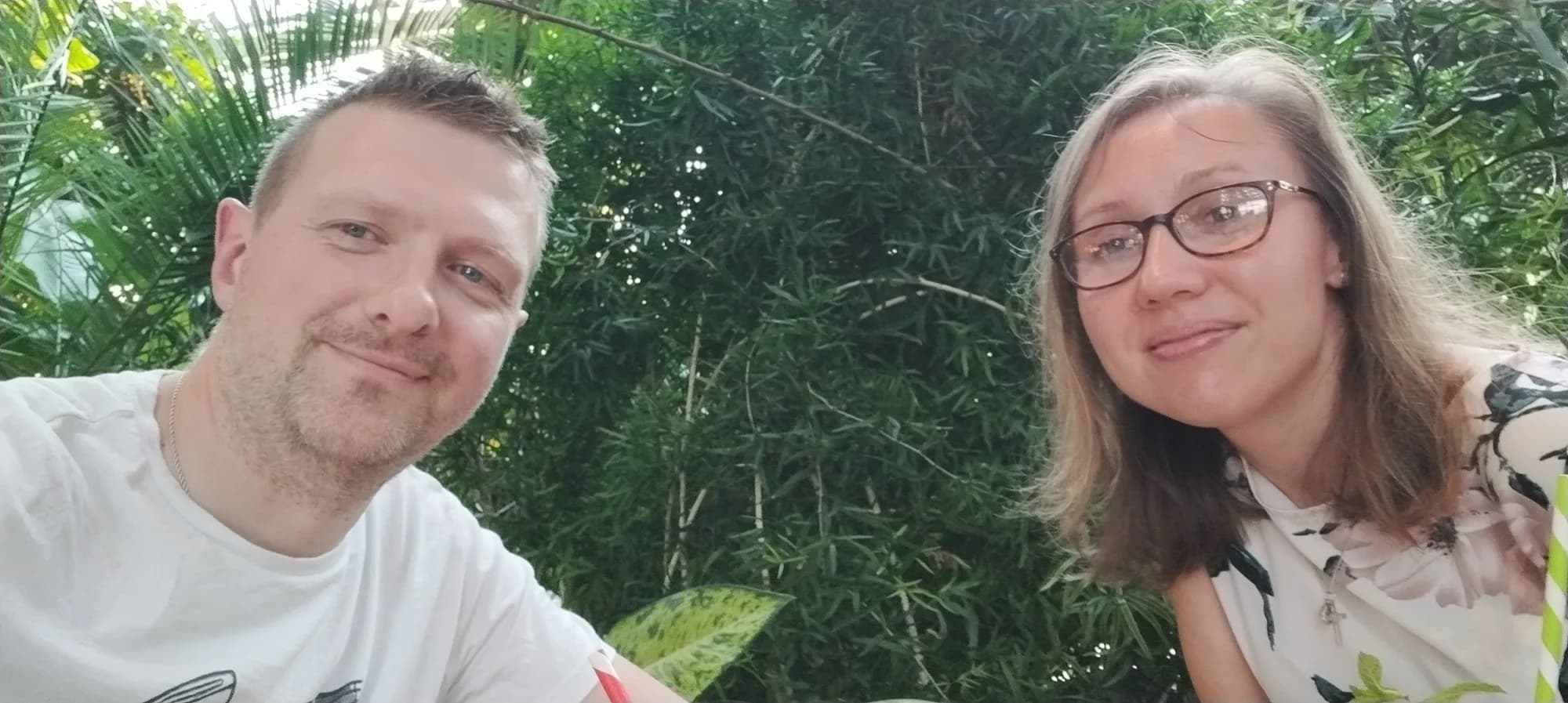
Arkadiusz (Arek) Dowejko
Co-founder · Software Engineer · Husband
Over 12 years as a software engineer, now building FertilityFlow. Podcaster and content creator on marriage — not as a therapist, but as a husband who spent nearly two decades studying what actually makes marriage work.
For most of his adult life, something felt off. Desk job, screens, weekends on the sofa. Moving to Poland shifted the mode: less screen time, more presence — at home, with family, with his hands in the work. He's renovating the house, chopping wood, riding a motorbike. Not as hobbies — as a way of actually being here.
He identifies with the autism spectrum (no formal diagnosis), which gives him a particular appreciation for clear, well-structured systems — and makes marriage to Monika a daily lesson in communication and flexibility. He spent 20 years in the UK. He brought his family back to Poland because he decided it was time to live with purpose.
Dr. Monika Dowejko
Co-founder · PhD in Reproductive Endocrinology · Certified FAM Instructor · Wife
Her PhD in reproductive endocrinology didn't begin in a laboratory. It began with 10 years of living with PMOS (formerly PCOS), with monthly disappointments, with adoption papers prepared and a pregnancy they didn't expect. She didn't just study fertility. She lived it.
She is a certified FAM/NFP instructor who trains other instructors online and does individual consultations with couples. She is not a medical doctor. She is a scientist, educator, and mother who teaches from 19 years of partnership — not from a manual.
When she discovered that FAM wasn't just about tracking cycles but about reclaiming agency over your body and your relationship, everything changed. She listens: to couples struggling to conceive, to women coming off hormonal contraception for the first time, to men learning to read their partner's cycle. She doesn't teach rules. She teaches understanding.
What we believe
A relationship is never only a private arrangement between two people. What a couple builds at home shapes their children, their friends and the street they live on. Change doesn't start with politics or large institutions. It starts in the bedroom and at the kitchen table, in every individual home.
The family is the first society
The home is where children learn to relate, to forgive, to take responsibility, and to cooperate. What they experience there shapes how they behave everywhere else. A strong home produces strong people.
Strong relationships heal culture
The deepest social crises of our time — loneliness, emotional instability, relational breakdown — are not solved by programmes or policies. They are solved one relationship at a time.
A strong relationship doesn't stop at the front door
It inspires the couple across the street. It anchors local networks. It builds the kind of trust between people that no institution can manufacture top-down.
Commitment goes against the grain
Modern culture promotes individualism. NatProFam promotes commitment — not because it is easy, but because lasting dedication to another person, and to the common good, is what strong communities are built on.
This is why FertilityFlow exists. Not to track cycles. To give couples the knowledge they need to understand each other more deeply — because a couple that knows each other better stays together better. And a couple that stays together better makes the world better, one home at a time.
Nineteen years of proof
Arek and Monika's story is not backstory. It is evidence that the mission is livable.
They married in 2008. Small wedding — about 20 people, a simple meal, then a few friends at home. They remember every minute of it because it was calm and unhurried. The first years brought multiple countries, no stable income, and no family nearby. They built their systems for marriage to work before they had the luxury of comfort.
Then came ten years of trying to start a family. Monika has PMOS. They went through fertility assessments, the weight of monthly disappointments, and eventually started the adoption process. Their first son was born naturally, while the adoption papers were already prepared. Their rule was simple: us against the problem, not me against you.
Their second son was born during the COVID pandemic — 1,488 km from family, no outside help, just the two of them. Monika developed postnatal depression. When she said "I can't cope," Arek took both children on walks for two hours. Every evening after the kids slept, he asked: "What was hardest today?" and "What can I do differently tomorrow?" It took six months. They got through it through prayer and by showing up for each other every day.
Arek also lost his job — in difficult circumstances, with two children and a mortgage. Same approach: us against the financial crisis. Weekly honest check-ins without panic or blame. Arek started his own business. He's happier now than he was as an employee.
Through all of it — infertility, depression, crisis, recovery — they practised natural family planning together for 19 years. Arek didn't just follow instructions. When Monika said "I don't want you to just follow my cycle — I want you to understand it," he started paying attention. He noticed patterns in her energy, mood, and needs. Biology became a shared language.
What we teach couples
Cycles were never the whole story. For years we have run courses for couples and talked with couples about their relationship, not only about fertility. What we teach is what got us through nineteen years: how to talk to each other, how to argue well, and how to keep a home where both people feel heard.
How to talk
Saying what you need without blame, and listening until the other person feels understood.
How to argue well
Disagreeing without hurting each other. Us against the problem, not me against you.
Communication at home
Small daily habits, like a short evening check-in, that keep two busy people close.
A happy marriage or partnership
Closeness, intimacy and shared plans, built on purpose rather than left to chance.
We teach from experience, as a married couple, not as therapists. If you are facing something serious, such as abuse, addiction or a deep crisis, please reach out to a couples therapist.
What they built — and why
After years of working with couples, and many questions about fertility, bodies, intimacy and family planning, Arek and Monika realised the tool didn't exist.
Most fertility apps are built for women. They treat the partner as an afterthought — a checkbox, a notification, a secondary profile. They're built by technology teams who understand cycles as data, not as lived experience shared between two people.
FertilityFlow is different because the people who built it have been living this for nearly two decades. Monika's PhD in reproductive endocrinology means the content is built on peer-reviewed science. Arek's 12 years of engineering went into making the daily entry take about a minute. And 19 years of doing this as a couple meant they were designing for two people from the start, not one.
Who FertilityFlow is for
FertilityFlow is for couples: married or not, with a faith or without one. Couples are the unit of design. Every feature was built with both partners in mind.
Couples trying to understand their natural fertility for the first time
Couples trying to conceive who want to track the right signs
Couples spacing their children who want to read her cycle together
Couples going through fertility challenges alongside medical care
Couples who have practised NFP or FAM before and want a better tool
Couples at the start of a life together who want to learn it as a team
If you heard about us on the radio, on a podcast, or through someone who knows us — welcome. This is the real story. We're a married couple who built the tool we wished we'd had, not a startup that spotted a market opportunity.
What FertilityFlow actually is
FertilityFlow helps couples observe and understand her fertility using three signs: basal body temperature (BBT), cervical mucus and her period. These are the signs Monika teaches, and the two of them have charted them together for 19 years. She logs in about a minute a day. He gets his own side of the app.
His Side
His own dashboard: her phase, what it can mean for her energy and mood, and simple ways to support her. She chooses what he sees.
Her chart, in his language
When the AI writes her a note about her chart, he gets his own version: no jargon, just what this week may feel like for her and how he can be there.
Daily Flower
For the days when words or time run short: a flower from the dashboard, with a short note or without one. The other one can say thank you or send one back.
Quiet reminders
A short reminder between 8:00 and 21:00. Nothing about health on the lock screen, and after three reminders with no entry they stop.
Together Month
Log on at least 90% of days in a month and collect 250 points, and you can swap them for a month of Premium, free.
Bad-night filter
Ill, or slept badly? Mark it in that day's entry and the reading is left out of the calculations, so one bad night doesn't throw off the chart.
FertilityFlow is not a medical device. It does not diagnose. It does not replace a doctor or a certified instructor. It is a clear, honest educational tool that helps couples build cycle awareness together.
Begin. Together.
Start for free and invite him whenever you're ready. No credit card, no commitment. A clearer picture of her cycle, and a shared language for the two of you.